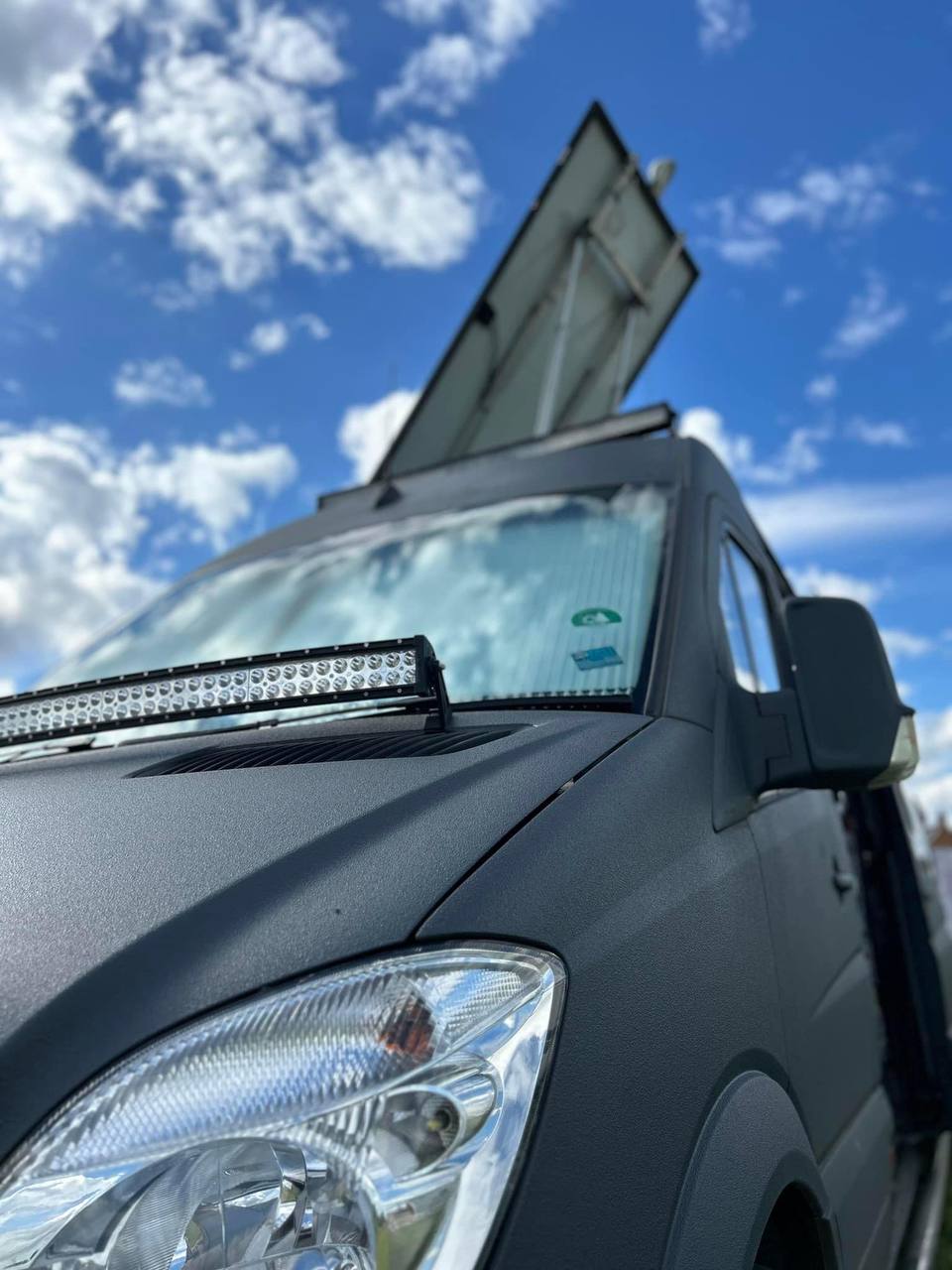
Most campervans mount their solar panels flat against the roof. It is simple, reliable and makes good use of otherwise unused space. But a flat panel is not always in the best position to capture the available sunlight, particularly when the Sun is low in the sky during the morning, evening or winter.
Rappy takes a different approach. The van has a 515W self-tracking solar panel designed to adjust its position and align itself more effectively with the Sun. That means the panel can make better use of the sunlight available throughout the day, rather than relying on a fixed, horizontal position.
Why track the Sun?
A solar panel generally produces more power when sunlight strikes its surface more directly. With a conventional flat roof installation, the panel’s angle is fixed, even though the Sun is constantly moving across the sky.
Rappy’s solar tracker is designed to change that. Instead of keeping the panel flat, the tracking system can move or level the panel towards the Sun’s position. The aim is to improve solar collection from the limited roof area available on a van.
This is not a claim that the tracker produces a guaranteed percentage more energy in every situation. Actual performance depends on weather, shading, the van’s location, the time of year, battery state of charge and the energy used by the tracking mechanism itself. However, the principle is straightforward: keep the panel better aligned with the Sun and give it a greater opportunity to collect useful energy across the day.
Where the Victron MPPT comes in
The tracker and the Victron MPPT have different jobs.
The solar tracker handles the mechanical side. It changes the panel’s position so the panel can receive sunlight more directly.
The Victron MPPT handles the electrical side. MPPT stands for Maximum Power Point Tracking. Rather than tracking the Sun’s position, the Victron controller continually searches for the panel’s best electrical operating point. It then converts the available solar energy into the correct charging voltage and current for the battery system.
In simple terms:
The tracker points the panel at the Sun. The Victron MPPT makes the most of the electricity the panel is producing.
That combination is what makes the system particularly interesting. Mechanical tracking improves the panel’s position, while electronic MPPT optimisation helps reduce the energy that might otherwise be lost between the solar panel and the batteries.
Charging Rappy’s lithium battery bank
The solar energy collected by the tracker is managed by the Victron system before being delivered to Rappy’s substantial 1,256Ah lithium battery bank. The MPPT charger controls the charging process through the appropriate stages, including bulk, absorption and float, depending on the battery’s condition and the available solar power.
Solar production is also part of Rappy’s wider integrated electrical system, which includes a Victron MultiPlus-II 5000VA inverter/charger, two Victron Orion XS 50A DC-DC chargers, a Victron Cerbo GX and a 7-inch GX Touch display. The system is integrated with Home Assistant, giving me a clear view of the van’s energy production, storage and consumption.
More than just adding watts
The advantage of tracking is not simply about the panel’s rated 515W capacity. A panel does not produce its rated output continuously. Real-world solar generation changes constantly with cloud cover, temperature, shading, the angle of the sunlight and the battery’s charging requirements.
By giving the panel a better angle for more of the day, Rappy’s tracker is designed to maximise the solar harvest from the available roof space. That can be especially useful when travelling off-grid, where every extra unit of energy collected can reduce the need for external charging or running another power source.
It is important to remember that a tracking system brings extra mechanical complexity compared with a fixed panel. A moving roof-mounted system needs to account for wind loading, weight, maintenance and safe stowage before driving. The tracker also consumes some energy while operating. In heavy cloud, shade or diffuse light, there may be less benefit from changing the panel’s angle.
That trade-off is the reason I chose to explore a more advanced solution for Rappy. A fixed panel is simpler, but a self-tracking array offers the potential to collect more useful sunlight from a limited van roof. Combined with Victron MPPT technology, it creates a system that works intelligently on both sides of the equation: positioning the panel mechanically and optimising its electrical output.
A smarter solar generator for a van
Rappy’s solar system is a good example of how campervan electrical design can go beyond simply bolting panels to the roof. The self-tracking panel is designed to follow the Sun, while the Victron MPPT ensures that the power being generated is efficiently managed and sent into the lithium battery bank.
There is no single solution that is perfect for every van. Fixed panels remain lightweight, simple and dependable. But where roof space is limited and maximising solar collection matters, combining solar tracking with Victron MPPT technology offers an innovative way to get more from the available sunlight.
For Rappy, the goal is simple: collect as much useful solar energy as possible, manage it intelligently and keep the van powered for longer when travelling off-grid.
Leave a Reply